
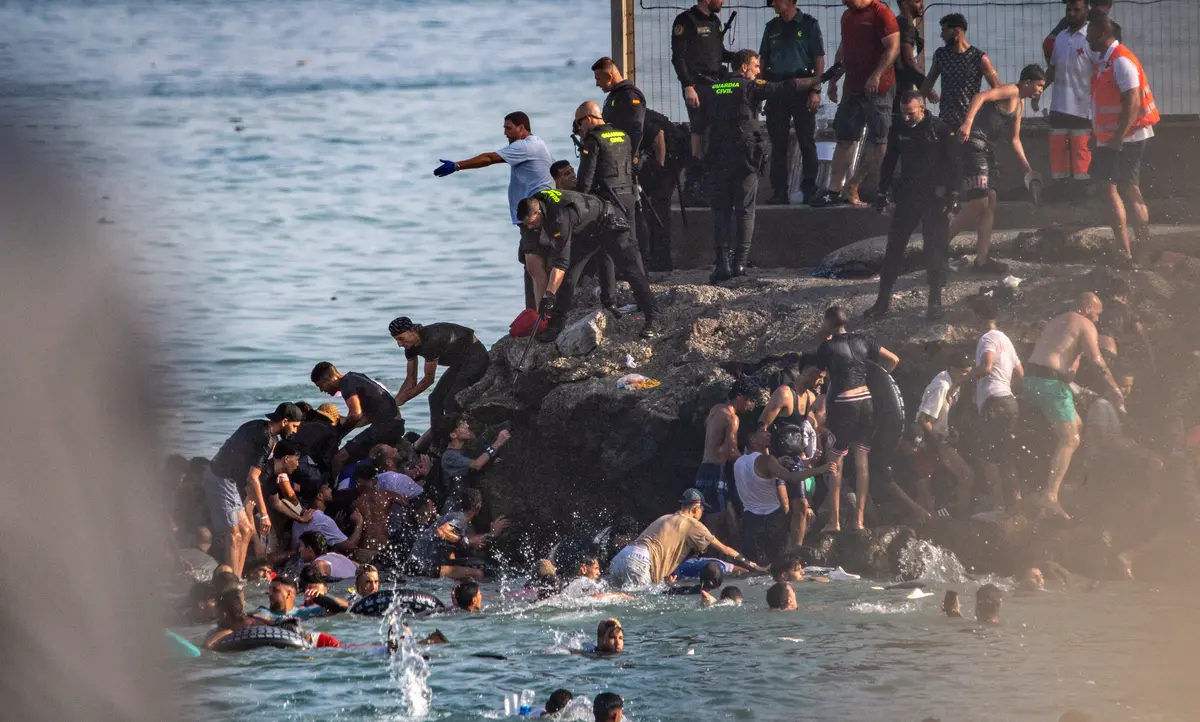
Spain has sent military and police reinforcements to Ceuta after thousands of migrants crossed from neighbouring Morocco, many by swimming around the coastal border barriers near Tarajal beach. The sudden movement overwhelmed local reception services, left people sleeping outdoors and led Ceuta's authorities to demand urgent help from Madrid.
At least nine people were reported dead during the mass crossings, although figures may change as rescue and identification work continues. The crisis involves border security, asylum law, organised smuggling, humanitarian protection and the difficult political relationship between Spain and Morocco.
What Happened During the Ceuta Migrant Surge?
Large groups moved towards Ceuta from the Moroccan side of the border during the final week of July 2026. Some entered through the sea near Tarajal, using inflatable rings or other flotation aids. Others moved around breakwaters or reached areas close to the border fence.
Reuters reported that around 1,500 people had reached Ceuta by swimming within one week before the largest scenes unfolded. Other estimates placed the wider number of recent arrivals at about 2,000 or more. Authorities have not published a single final figure covering every arrival, interception, rescue and return.
Videos showed families, young adults and children entering Spanish territory while police, rescue workers and volunteers responded. Moroccan security forces attempted to hold back further groups, while Spain reinforced the Civil Guard and National Police.
Where Is Ceuta and Why Is It Part of Spain?
Ceuta is a small Spanish autonomous city on the North African coast. It borders Morocco but is governed by Spain and forms part of the European Union. Together with Melilla, it creates one of the EU's only land borders with Africa.
This location gives Ceuta strategic importance. People who enter the city have reached Spanish territory, although Ceuta is outside the passport-free movement arrangements applied across most of mainland Spain. Migrants cannot automatically travel from Ceuta to continental Europe simply because they crossed the local border.
The border includes fences, surveillance systems, official checkpoints and coastal barriers extending into the sea. The Tarajal area has repeatedly become a crossing point because swimmers can try to move around the end of the marine barrier.
What Caused the Sudden Ceuta Surge?
Spanish and Moroccan authorities had not identified one confirmed trigger when the crisis began. The surge appears to have developed through several factors rather than one public announcement or event.
People attempting the crossing may have reacted to rumours that Spain's legal rules had changed. Smuggling networks can spread misleading claims through social media and private messaging, telling migrants that a short opportunity has opened at the border.
A recent Spanish Supreme Court decision also became part of the debate. The ruling limited immediate or summary returns of people intercepted at sea when legal safeguards had not been followed. Spanish security officials warned that criminal networks may have presented the judgment as an assurance that anyone reaching the water or Spanish territory could remain.
That interpretation is misleading. The ruling does not provide automatic residence, asylum or free movement into mainland Europe. It requires authorities to process people according to Spanish and international law, including individual identification and access to relevant procedures.
Longer-term causes remain important. Unemployment, poverty, conflict, political insecurity and limited opportunities continue to push people towards irregular routes. Ceuta's physical proximity to Morocco makes it appear reachable, even though the sea crossing can be fatal.
Did Morocco Allow the Border Crossings?
Moroccan forces were reported to have blocked and intercepted large numbers of people as the surge continued. Spain said it was coordinating with Moroccan authorities, while Morocco also blamed human-trafficking and smuggling networks for encouraging the crossings.
The question remains politically sensitive because border control has previously become connected to disagreements between Madrid and Rabat. During the May 2021 crisis, about 8,000 people entered Ceuta over two days after Moroccan border controls appeared to loosen amid a diplomatic dispute.
The 2026 situation has again raised suspicion about whether cooperation weakened before the mass movement. However, available reporting does not establish that Morocco deliberately organised or authorised the latest crossings. Claims about state involvement require evidence and should not be treated as confirmed fact.
Why Did Spain Deploy the Military to Ceuta?
Spain deployed military personnel to support border security and restore order after local resources became overwhelmed. The armed forces were expected to assist the Civil Guard and police rather than replace civilian control of immigration processing.
The response included additional personnel, maritime support and stronger patrols near the coastal border. Rescue teams continued searching the water, while officials worked to identify new arrivals and move vulnerable people into accommodation.
Ceuta's regional president, Juan Jesús Vivas, described the situation as a national emergency and asked the central government for a coordinated response involving several ministries. Spain's Interior Ministry initially resisted formally declaring a national emergency but promised urgent support and high-level visits.
Why Are Ceuta's Reception Centres Overwhelmed?
Ceuta has limited land, accommodation and public services. Its reception system cannot easily absorb thousands of people arriving within days. The pressure is especially serious for unaccompanied minors, who must receive protection and cannot be treated in the same way as adult migrants.
Local officials said facilities for minors were operating far beyond their intended capacity. Hundreds of children were under Ceuta's care, while adult reception centres and registration services also faced long queues. Some new arrivals reportedly slept outside while awaiting processing.
Authorities must establish identity, age, nationality, family links and possible protection needs. These checks take time. Determining whether a young person is under 18 can also become complicated when documents are unavailable.
What Happens to Migrants Who Reach Ceuta?
Reaching Ceuta does not automatically give a person the right to remain in Spain. Authorities register each arrival and assess the person's legal position. Someone who requests asylum must be allowed to present a claim and receive an individual decision under the applicable procedure.
People who do not qualify for protection may face return to Morocco or their country of origin, depending on nationality, readmission agreements, documentation and legal safeguards. Spain and Morocco said they were discussing faster returns after the surge, but immediate group expulsions can conflict with due-process requirements.
Unaccompanied children receive separate protection. Spain must assess their age and welfare, provide care and consider family circumstances. The debate over transferring minors from Ceuta to other Spanish regions has intensified because the enclave cannot manage the numbers alone.
How Dangerous Is the Sea Route Around Tarajal?
The route may appear short, but currents, exhaustion, cold water, overcrowding and panic make it dangerous. Some people enter without adequate swimming ability or rely on unsuitable flotation devices. Night crossings and poor visibility increase the risk.
At least nine deaths were reported during the latest mass crossing. Ceuta's leader also referred to dozens of sea deaths recorded over a longer period. Each number represents a separate investigation, so totals reported for one day, one week and the full year should not be combined without care.
Spanish maritime rescue services, the Civil Guard, the Red Cross and local emergency teams helped people in the water and treated those who reached shore. The deaths have reinforced calls for measures that prevent dangerous departures while preserving access to lawful protection.
How Is the 2026 Ceuta Crisis Different From 2021?
The two events share important features. Both involved unusually large movements from Morocco, people swimming around coastal barriers and Spain deploying security reinforcements. Both also overwhelmed Ceuta and created political pressure on the Spanish government.
The 2021 surge unfolded during a clear diplomatic conflict between Spain and Morocco and involved about 8,000 arrivals in two days. The July 2026 surge developed over roughly a week before a larger breach, and its immediate trigger remained less certain.
The legal context has also changed. Court decisions and stronger attention to individual procedures make rapid returns more complicated. Reception capacity for minors was already severely stretched before the latest arrivals.
What Does the Ceuta Surge Mean for Europe?
Ceuta is a Spanish city, but its border also represents the external boundary of the European Union. A sudden breakdown there becomes a European security and humanitarian concern. It can influence debates about asylum rules, border funding, returns and cooperation with neighbouring countries.
The surge may also intensify political arguments inside Spain and across Europe. Some parties will demand tougher border measures, while rights groups will focus on safe processing, protection for children and preventing deaths at sea.
Cooperation with Morocco will remain central. Spain needs Moroccan authorities to disrupt smuggling networks and prevent mass departures. Morocco, in turn, seeks economic, political and migration cooperation from Spain and the EU.
Follow the latest world news and international explainers for updates as official figures and policy decisions emerge.
What Could Happen Next in Ceuta?
Spain is likely to keep reinforcements in the area until arrivals fall and the border is stabilised. Authorities will continue registration, asylum screening, age assessments and negotiations over returns.
Madrid may move adults or minors to other parts of Spain to reduce pressure on Ceuta. It may also seek more EU assistance and stronger cooperation with Morocco. Investigations will examine whether smuggling networks coordinated the movement or spread false information about Spain's court ruling.
The final impact will depend on whether crossings continue. A rapid decline would allow services to regain control. Continued attempts could create a prolonged humanitarian emergency and deepen political tension between border authorities, the Spanish government and European partners.
Ceuta Migrant Surge FAQs
What is the Ceuta migrant surge?
It is a sudden mass movement of migrants from Morocco into Spain's North African city of Ceuta, mainly through coastal areas near the Tarajal border.
How many migrants entered Ceuta?
Reports initially described around 1,500 arrivals within one week, while broader estimates reached about 2,000 or more. A final verified total had not been established.
Why are migrants trying to enter Ceuta?
Ceuta is Spanish and EU territory next to Morocco. Economic hardship, insecurity, rumours about legal changes and encouragement from smuggling networks may all influence attempts to cross.
Did Spain send the army to Ceuta?
Yes. Spain deployed military reinforcements to support the Civil Guard and police after the border and reception system became overwhelmed.
Does entering Ceuta guarantee asylum in Spain?
No. Entry does not guarantee asylum, residence or transfer to mainland Spain. Each person must be registered and assessed through the relevant legal process.
Why can Spain not immediately return everyone?
Spanish and international law require individual safeguards, especially when a person requests asylum or may be a child. Courts have restricted summary returns that bypass legal procedure.
Is Ceuta in Europe or Africa?
Ceuta is geographically located in North Africa but is politically part of Spain and the European Union.
Ceuta Surge Explained in Simple Terms
The Ceuta migrant surge happened because thousands of people moved towards a uniquely exposed EU border within a short period. Rumours, smuggling networks, economic pressures and confusion about a court ruling may have contributed, but no single cause has been confirmed.
Spain's immediate task is to secure the border, rescue people at sea and process arrivals lawfully. Its longer challenge is to expand reception capacity, protect children, work with Morocco and prevent another deadly rush towards Ceuta.